Playing Ground: A Whimsical Font for Playful Design Projects
Typography shapes how an audience perceives your work. When the goal is to evoke warmth, joy, or childlike wonder, a font like Playing Ground can become a central tool. This compact, charming typeface is built around small characters and a cartoon-inspired aesthetic, giving it an approachable personality that stands apart from more neutral or formal letterforms. But no single typeface fits every scenario. Understanding what Playing Ground offers, where it shines, and where it may fall short helps you decide if it belongs in your next design.
What Makes Playing Ground Distinct
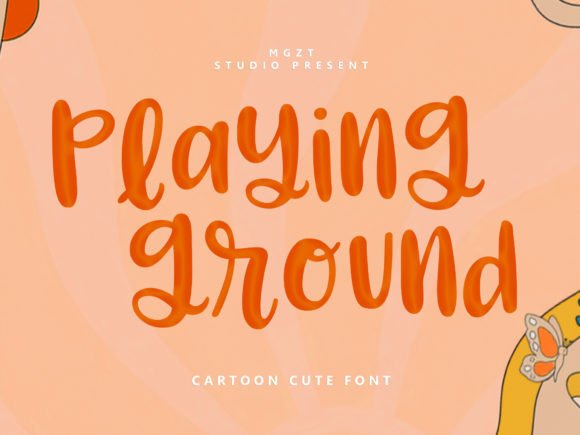
Playing Ground is not another generic handwritten font. Its characters are deliberately compact, which is unusual for a playful typeface. Many playful fonts rely on exaggerated proportions—tall ascenders, wide curves, or dramatic flourishes. Playing Ground instead keeps its letters petite, with a consistent x-height that reads clearly at small sizes. The design leans into simplicity: rounded terminals, a gentle stroke contrast, and shapes that feel drawn rather than typed. This combination creates a sweetness that does not sacrifice readability.
The font is best described as whimsical without being noisy. Each letter retains enough individuality to feel handmade, yet the overall rhythm remains steady. This balance makes it suitable for projects where you want a friendly tone but still need the text to be easily parsed—think short headlines, labels, or callouts rather than dense paragraphs.
When a Playful Font Makes Sense
Fonts like Playing Ground work best when the message itself is lighthearted or emotional. Children’s book covers, party invitations, toy packaging, and branding for creative services often benefit from a typeface that signals warmth. In these contexts, a formal serif or a sterile sans-serif can feel cold or distant. Playing Ground bridges the gap—it is cute without being childish, and stylized without being illegible.
It also fits scenarios where you want to humanize a project. A dental office for kids, a bakery’s product tag, or a school event poster all have a need for something approachable. The compact size helps the font feel intimate, as if the text was written by hand on a small note. That intimacy can build trust, especially for audiences tired of polished corporate design.
Comparing Playful Font Categories
To evaluate Playing Ground, it helps to look at the broader category of decorative typefaces. Playful fonts generally fall into three groups: those that mimic handwriting, those that exaggerate features for comic effect, and those that reduce letterforms to the simplest delightful shapes. Playing Ground sits between the first and third group. It has the irregularity of handwriting but avoids the loops and swirls that can slow reading. Compared to many cartoon-style typefaces, it is restrained. The letters do not bounce wildly on the baseline; they stay aligned, which improves legibility for longer phrases.
Another common alternative is a fat or rounded sans-serif. Those fonts often feel friendly but lack the handmade charm that Playing Ground brings. If your project needs a personal, almost tactile quality, the subtle unevenness in Playing Ground’s character shapes gives that feel better than a perfectly geometric round font. However, if you need maximum readability for body text or small captions under 10 point, a clean sans-serif or a classic book face might still outperform it.
Strengths
- Readability at small sizes: The compact letterforms keep spacing tight, so words remain coherent even when reduced. This is rare among playful fonts, which often lose clarity as they shrink.
- Emotional tone: The font consistently delivers a sense of cuteness and joy without feeling forced. It is versatile enough for both children’s media and whimsical adult branding.
- Simplicity: Each letter is stripped down to essential curves. This makes it easier to pair with other design elements without visual clutter.
- Compatibility with illustrations: Because it resembles a drawn style, it integrates naturally with cartoon art, watercolor elements, or any organic graphic.
Tradeoffs
- Limited for long text: The charm of the font works best in short bursts. Extended reading may cause fatigue because the small, playful forms feel energetic rather than restful.
- Compact proportions: The small x-height and tight letter spacing can reduce readability at very large display sizes; the sweetness may turn into visual density if scaled up for headlines.
- Niche appeal: Serious or formal projects—like legal documents, luxury branding, or tech interfaces—would feel mismatched. Trying to force playfulness into such contexts can undermine credibility.
Best-Fit Use Cases
Playing Ground excels in contexts where friendliness is a priority. Consider these realistic examples:
- Children’s book cover or title page: The font matches the imaginative tone of illustrated stories. A title like “The Little Cloud Who Wanted to Rain” would feel natural in Playing Ground.
- Branding for a kid-friendly café or bakery: A menu board or logo using this typeface immediately signals warmth. Because the font is compact, it can fit neatly into a stamp or circular logo without loss of clarity.
- Educational materials for early readers: Flashcards, workbooks, or classroom posters benefit from a clear but playful typeface. The connection between letters is simple enough that children can easily recognize shapes.
- Social media graphics: Posts aiming for a cozy, handmade aesthetic—think craft shops, family blogs, or event announcements—can use Playing Ground for short quotes or headings.
Limitations to Consider
No single font solves every design problem. Even a charming typeface like Playing Ground has boundaries worth noting.
First, its compactness means that if you need strong impact from a distance—like a large billboard or a trade show banner—the letters may feel too small or dense. A bolder, more open font would likely deliver better readability at those scales. Second, the playful mood can unintentionally trivialize serious content. An annual report for a nonprofit or a medical instruction leaflet would not benefit from this style. Third, the font’s character set may be limited; check for special characters, accented letters, or multi-language support if your project requires them.
Another practical limitation is pairing. Playing Ground looks best as the dominant voice in a composition. If you need a secondary font for body copy or detail information, choose a neutral, highly readable typeface—such as a humanist sans-serif like Verdana or a lightweight serif—to avoid competing personalities.
Making the Right Choice for Your Project
Deciding whether to use Playing Ground comes down to three questions: What emotion should the text carry? How much text will there be? And how does the font interact with your overall visual system?
If the answer to the first question is warmth, joy, or approachability, and the text is short or medium-length, Playing Ground is a strong candidate. For longer copy, you might reserve the font for headings and use a simpler companion for body text. If your project already has strong illustration or colorful graphics, Playing Ground can complement without overpowering—its simplicity keeps focus on the images.
If your audience is predominantly adults in a professional setting, or if the context demands formality, this typeface is not the right choice. In those cases, look for a clean geometric sans-serif or a traditional serif, and reserve playfulness for accent words or badges.
Ultimately, typeface selection is about alignment. Playing Ground brings a distinct cuteness that few other fonts replicate without becoming too decorative. Its compact proportions and restraint make it a practical tool when you need charm and readability in equal measure.
When evaluating any playful font, test it at both small and large sizes, in your actual layout, and with your target audience in mind. Playing Ground has a well-defined niche—children’s media, whimsical branding, and friendly communications. Within that niche, it performs reliably and delightfully.
For projects that live outside that niche, exploring other options will likely yield a tighter fit. But for those moments when you want a design that smiles without shouting, Playing Ground is a graceful, compact answer.