The Art of Continuous Line Monograms with F One Line Beautiful Letter
Understanding the Aesthetic of Single-Stroke Lettering
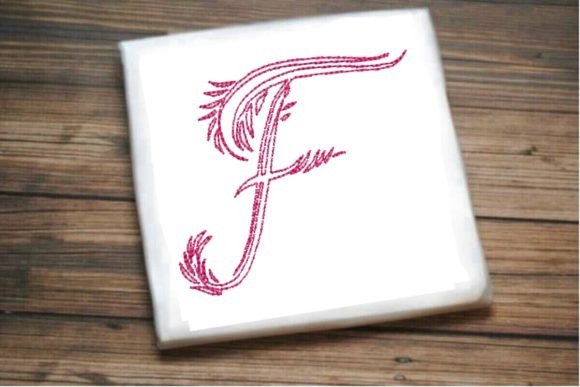
There is something inherently satisfying about a letter formed without lifting the pen, or in this case, without breaking the stitch path. F One Line Beautiful Letter captures this minimalist philosophy by rendering the letter "F" as an uninterrupted embroidery sequence. Unlike traditional digitized monograms that may rely on jump stitches or layered satin columns, this design prioritizes flow and economy of movement. The result is a monogram that feels both modern and timeless, as if drawn by a single confident hand gesture.
For embroiderers who appreciate clean lines, this approach reduces the visual clutter that sometimes accompanies multi-step digitizing. The continuous line also means fewer thread breaks and trims, which can translate to smoother stitching sessions. When you examine the finished embroidery, the eye follows the path naturally, creating a sense of rhythm that discrete letter segments cannot replicate.
Technical Specifications and File Compatibility
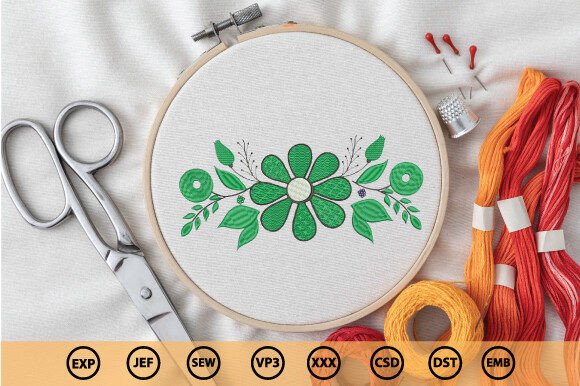
Machine embroidery thrives on precise format matching, and F One Line Beautiful Letter accommodates a broad range of hardware. The design typically arrives in multiple file extensions including DST, PES, EXP, JEF, VP3, and XXX, among others. This breadth ensures that whether you run a single-needle home machine or a multi-head commercial unit, you can load the design without conversion headaches.
Stitch count for a single letter tends to be modest, often ranging between 2,000 and 4,000 stitches depending on the chosen size. This low count means quick run times and minimal thread usage, making the design suitable for high-volume production as well as one-off personal projects. The design density is balanced to provide coverage without over-penetrating delicate fabrics.
- DST – Standard Tajima format, widely used in commercial settings
- PES – Brother and Baby Lock machines
- EXP – Melco and compatible systems
- JEF – Janome embroidery machines
- VP3 – Husqvarna Viking and Pfaff
- XXX – Singer and other generic platforms
Checking hoop size requirements before purchasing is wise. Most versions of F One Line Beautiful Letter are digitized for standard 4x4 and 5x7 hoops, though larger formats may be available for those using multi-position hooping or extra-large frames.
Fabric Selection and Stabilizer Considerations
Because a continuous line design relies on clean stitch formation, fabric choice plays a critical role. Woven cottons, linens, and denims provide stable bases that hold the stitches crisply. Knits and stretch fabrics require careful stabilization to prevent distortion of the flowing line. A tear-away stabilizer works well for stable wovens, while cut-away stabilizer is recommended for knits or items that will endure repeated washing.
Testing on a scrap piece before committing to the final garment is a practice I have found invaluable. The continuous nature of the design means that any fabric puckering or tension issue will be visible along the entire letter path. Once you confirm the combination works, the actual embroidery proceeds quickly due to the low stitch count.
Applications Across Personal and Commercial Projects
The versatility of F One Line Beautiful Letter becomes apparent when you consider where monograms appear. Personalizing a bathrobe or set of hand towels for a housewarming gift feels elevated when the lettering has this refined, unbroken quality. For business owners, adding the initial to uniform caps, aprons, or tote bags creates a cohesive brand marker without overwhelming the garment.
I have seen this design used effectively in wedding decor, where the couple's shared initial appears on linen napkins, favor tags, and even the bride's jacket cuff. The single-line aesthetic complements both rustic, hand-lettered themes and sleek contemporary wedding palettes. Educators teaching embroidery basics find this design useful for demonstrating stitch path planning and tension adjustment, as students can clearly see how each segment connects.
For hobbyists who enjoy layered embroidery, the F One Line Beautiful Letter can serve as a base element combined with decorative borders or floral motifs. Because the monogram itself remains understated, it anchors more ornate additions without competing for attention.
Color, Thread Type, and Visual Impact
The continuous line format invites experimentation with thread color and finish. A metallic thread in gold or silver transforms the design into something jewelry-like, especially on dark fabrics. Variegated threads add subtle dimension along the length of the letter, with color shifts occurring naturally as the stitch path progresses. Solid rayon or polyester threads produce clean, consistent results suitable for corporate or formal applications.
Dark backgrounds with light thread create strong contrast, making the monogram pop. Conversely, tone-on-tone stitching using a slightly lighter shade than the base fabric yields an elegant, subtle embossed effect. The choice depends entirely on the intended use: high-contrast for visibility and branding, low-contrast for personal luxury items.
- Select thread weight appropriate for the fabric – 40-weight is standard for most applications
- Test color combinations on fabric swatches before the final run
- Consider using polyester thread for items requiring high durability and colorfastness
- For delicate fabrics like silk or chiffon, reduce upper thread tension slightly
Digitizing Quality and Stitch Path Optimization
Not all single-line designs are created equal. The quality of digitizing determines whether the monogram looks gracefully hand-drawn or appears jagged and uneven. F One Line Beautiful Letter benefits from careful path planning that minimizes sharp angles and maintains consistent curvature through the loops and stems of the letter. Good digitizing anticipates how the fabric will respond to each stitch, distributing density evenly.
Poorly digitized single-line designs often show visible node points where the digitizer placed too many anchor points, resulting in a faceted rather than smooth curve. The well-crafted version of this monogram flows through transitions naturally, whether it is the upward stroke of the lowercase stem or the sweeping crossbar of the uppercase form. When you zoom into the digital preview, the path should appear as one continuous curve with minimal abrupt direction changes.
Experienced users can examine the stitch file in embroidery software to verify underlay patterns and compensation settings. These details matter less for casual home use but become critical when scaling production or working with challenging fabrics.
Scaling and Proportional Adjustments
One practical advantage of F One Line Beautiful Letter is that scaling the design up or down retains the essential character of the letterform, provided the digitizer set appropriate limits. However, embroidery has physical constraints: shrinking the design too much causes stitches to crowd, while enlarging beyond the original digitized size can expose gaps between stitch rows.
If you plan to use the monogram across multiple item sizes such as small shirt cuffs and large backpacks, consider purchasing the design in the approximate sizes you need rather than resizing drastically. The original digitizing for each size accounts for fabric pull compensation and stitch density. As a rule of thumb, stay within 10 to 15 percent of the original dimensions for best results.
Combining the Monogram with Other Design Elements
A single letter stands well on its own, but many embroiderers want to build compositions. Because the continuous line has a distinct visual rhythm, pairing it with geometric borders, circular frames, or linear accents works harmoniously. The monogram can sit at the center of a crest, along the spine of a book cover, or as part of a larger monogrammed set with additional letters.
When combining with other elements, be mindful of stitch direction and density. A dense patch surrounding a delicate line monogram may cause the fabric to pucker. I typically recommend stitching the continuous letter first, then adding surrounding elements in subsequent hooping steps or using a multi-design file if available. This approach preserves the crispness of the single line.
Maintenance and Longevity of the Finished Embroidery
Embroidered items inevitably face washing, wearing, and general use. The continuous nature of F One Line Beautiful Letter actually improves longevity in some respects. Fewer thread tails and jump stitches mean fewer loose ends that could fray or snag. The design's low density also reduces the risk of thread breakage during wear, as there is less surface area for friction.
For items that will be laundered frequently, such as towels or children's clothing, using quality thread and appropriate stabilizer is essential. A cut-away stabilizer left in place behind the embroidery provides ongoing structure, while tear-away stabilizers should be fully removed after stitching to avoid stiffness. Washing inside out and air drying further protects the integrity of the monogram.
Creative Experimentation Beyond the Traditional
While the design originates as a monogram letter, creative users have adapted it for purposes beyond initials. The continuous line "F" can represent a company logo, a single-letter brand mark, or even a decorative element that simply pleases the eye. Some embroiderers stitch the design on felt patches that can be attached to bags or jackets, allowing the monogram to be moved between items.
Using multiple colors in the same needle by manually threading different sections is possible if your machine supports color changes. This technique transforms the continuous line into a gradient or striped effect along the letter path. The design's simplicity invites such experimentation without overwhelming the stitcher with complex registration requirements.
For those who teach embroidery workshops, F One Line Beautiful Letter serves as an excellent project for intermediate students who have mastered basic fills and want to explore design composition. The single-line format challenges them to think about stitch path sequencing and tension control in a focused way.
Staying Updated with New Releases
The embroidery design market continually evolves, with digitizers releasing new lettering styles, size variants, and themed collections. Following the store that offers F One Line Beautiful Letter ensures you receive notifications when additional letters become available, or when the designer expands the set to include full alphabets or alternate script styles. Many creators also offer seasonal updates or bundle deals for returning customers.
Checking the store periodically reveals complementary designs that pair well with this monogram, such as decorative frames, ornamental borders, or matching number sets. Building a library of compatible designs expands your creative options without requiring separate digitizing for each project.